If you’ve always lived in a subdivision or in town, you’ve probably never thought about where the water goes after it leaves your sink. On rural land in North Georgia, the answer is usually your own septic system. It’s one of the biggest practical changes of moving to land, and it’s simpler than most people expect.
How does a septic system work on rural land?
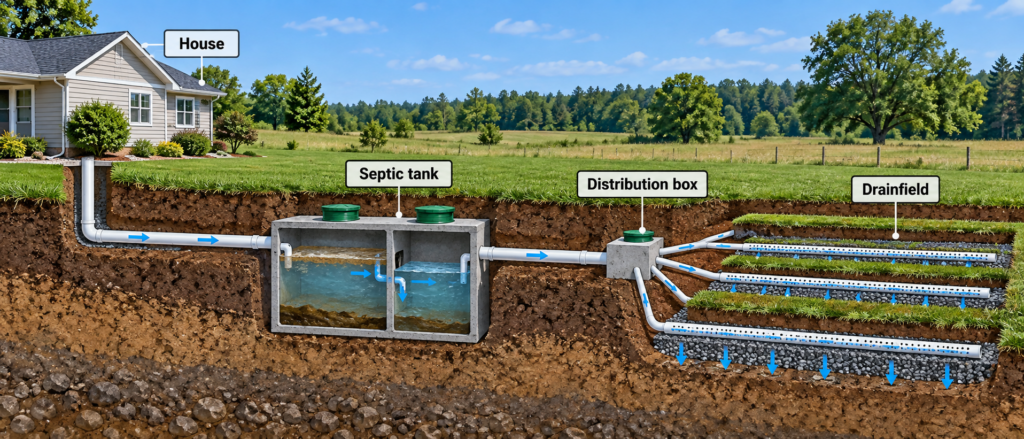
A septic system treats your home’s wastewater right on your property. Water from the house flows into an underground tank, where solids settle and separate. The liquid then flows out into a drain field, where the soil naturally filters and treats it. There’s no city sewer line and no monthly sewer bill.
Here’s what happens, step by step:
- Wastewater leaves the house. Everything from sinks, showers, toilets, and the washing machine flows through one main pipe to the septic tank.
- The tank separates it. Inside the buried tank, heavy solids sink to the bottom and form a layer called sludge. Grease and lighter material float to the top as scum. Bacteria in the tank break down some of the solids over time.
- Liquid moves to the drain field. The clearer liquid in the middle, called effluent, flows out of the tank into the drain field. This is a set of trenches or chambers with perforated pipe, buried in the yard.
- The soil finishes the job. The effluent seeps slowly into the ground, where soil and natural microbes filter and treat it before it reaches groundwater.
That’s the whole system: a tank, a drain field, and the soil doing the work.
What changes when you move from city sewer to septic?
The biggest change is ownership. With city sewer, the system belongs to someone else. With septic, it’s yours, which means a little more responsibility and a lot more independence.
|
|
City sewer |
Septic system |
|
Who owns it |
The city or county |
You |
|
Monthly sewer bill |
Yes |
No |
|
Where wastewater goes |
Public treatment plant |
Your tank and drain field |
|
Maintenance |
Handled by the utility |
Periodic inspection and pumping, arranged by you |
|
What goes down the drain |
Matters less |
Matters a lot |
|
Room needed on the property |
None |
Space for the tank and drain field |
For most families, the adjustment comes down to a few new habits and knowing where your system is on the property.
What does a perc test have to do with septic?
A septic system only works if the soil can absorb and treat water at the right rate. A perc test, short for percolation test, evaluates exactly that. It shows how the soil on a property handles water, which shapes where a drain field can go and what kind of system fits.
On raw land, this is one of the biggest unknowns. Buyers often don’t find out how the soil performs until after they’ve already chosen the property.
That’s why every Millwood property is Build Ready, with the perc test completed by a licensed soil scientist before you ever walk the land. You’re not guessing about the soil. The full Build Ready standard includes:
- Driveway installed
- Homesite partially cleared
- Underground power installed
- Perc test completed
- Boundary survey completed
- Property lines marked
- Road access in place
The soil information is already in hand, so you and your builder can move straight to planning your home and septic system. [Link: What Is a Perc Test article]
How do you get a septic system approved in Georgia?
In Georgia, septic systems are permitted through your county’s environmental health office, which operates under the Georgia Department of Public Health. Jackson, Banks, and Hall Counties each have their own office.
The general path looks like this:
- Plan your home. The system is sized to the house, commonly based on the number of bedrooms, so your home plans come first.
- Apply for a permit. You or your builder submit an application to the county environmental health office, along with the soil information for the property.
- Design and review. The county reviews the site and soil information and approves a system design and location.
- Installation and inspection. A licensed septic installer puts the system in, and the county inspects it before it’s covered.
Requirements and steps can vary by county, so check with the environmental health office where your land sits. Your builder will usually handle much of this process as part of building your home.
There are also different types of systems. Most homes use a conventional system, where gravity carries effluent to the drain field. Some properties call for an alternative design, like a chamber system or one with a pump. The county determines what’s right for your site.
Can you have a septic system and a private well on the same land?
Yes, and on rural land it’s the standard setup. All Millwood properties use a private well for water, so your well and septic system will share the property.
The key is placement. State and county rules set minimum distances between a well and a septic tank or drain field, so the two are planned together from the start. Your county environmental health office confirms the required distances, and your builder, well driller, and septic installer work from the same site plan.
Think of it as one layout decision: where the house sits, where the well goes, and where the septic system goes. [Link: well article]
How do you take care of a septic system?
A well-cared-for septic system can serve a home for many years. Most of the care is simple habits.
- Have it inspected and pumped regularly. The EPA recommends inspection by a professional about every three years, with pumping typically every three to five years, depending on household size and use.
- Only flush toilet paper. Wipes (even “flushable” ones), paper towels, and feminine products don’t break down and can clog the system.
- Keep grease out of the drain. Cooking oil and fat build up in the tank. Wipe pans and toss grease in the trash.
- Go easy on harsh chemicals. Bleach, drain cleaners, and paint can kill the bacteria the system relies on.
- Spread out water use. Running several loads of laundry in a row can overload the drain field. Space them out through the week.
- Protect the drain field. Don’t drive or park on it, build over it, or plant trees nearby whose roots can reach the pipes. Grass is the best cover.
- Know where everything is. Keep a simple map of your tank and drain field so you can find them for service.
What are the signs a septic system needs attention?
Call a septic professional if you notice any of these:
- Slow drains throughout the house
- Gurgling sounds in the pipes
- Sewage odors inside or outside
- Soggy ground or unusually green grass over the drain field
- Water or sewage backing up into drains or toilets
Catching these early usually means a simpler fix.
Is living with septic worth it?
For most people moving to land, septic becomes something they rarely think about. A few habits and occasional service are the tradeoff for something much bigger: room to spread out, a home built the way you want it, and land that’s truly yours.
No shared sewer line. No one else’s rules about how you use your property. Just your land, your home, and the space to live the way you’ve imagined.
Thinking about making the move to land? Get the free Land Buyer’s Field Guide for a clear, plain-language look at what to know before you choose land in North Georgia.