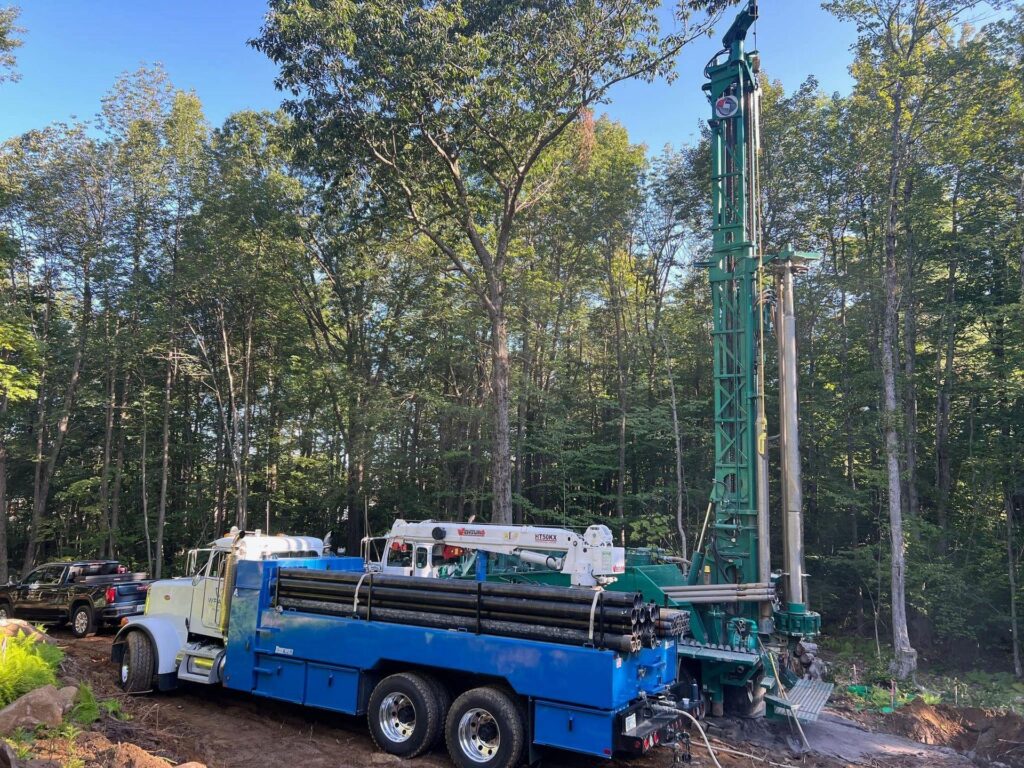
When you picture the house you want on acreage, you probably picture it finished: the driveway in, the lights on, and water running at the kitchen sink.
On many rural properties, that last piece comes from a private well installed as part of the building process. Drilling a well in North Georgia generally follows a familiar sequence, but its final depth, water yield, quality, and cost cannot be known with certainty before the work begins.
A few variables influence most of the planning. This guide explains where a well may go, how drilling works, what per-foot pricing may include, what water testing can reveal, and which questions to ask before signing a contract.
What determines the cost and placement of a well?
Three variables have an especially important role.
Depth usually determines the largest portion of the drilling cost because contractors commonly price well drilling by the foot.
Distance from the well to the house affects trenching, water-line, and electrical costs.
The septic plan influences placement because the well must maintain the applicable separation from the septic system and other potential contamination sources.
Once those three variables are better understood, the remaining components become easier to identify. They may still represent meaningful costs, however, so every item should be addressed in the contractor’s written scope.
Well placement starts with the complete site plan
The well, septic system, home, driveway, and utilities all need space on the same property. Deciding where one component will go can narrow the options for the others.
Georgia’s onsite-sewage rules establish minimum separation requirements between wells, septic components, and certain property features. For example, a septic tank generally cannot be installed within 50 feet of an existing or proposed well. Additional requirements may apply to absorption fields, property lines, surface water, and other site features.
One statewide measurement is not enough to establish a final plan. Buyers should confirm all applicable requirements with the county environmental health office and the qualified professionals involved with the property.
A useful starting point is soil first, followed by a coordinated plan for the:
- Septic system
- Well
- Homesite
- Driveway
- Utilities
- Future improvements
The soil evaluation helps identify where the property may support an onsite sewage system. The septic area cannot simply be moved to a more convenient location unless the soil and an approved plan support that change.
The well location usually offers more flexibility, but it still needs to satisfy applicable setbacks and work with the terrain, property boundaries, and construction plan. The house may then be positioned so all three major elements function together.
A large open area can have fewer workable configurations than its acreage initially suggests. That is why it helps to begin the conversation with documented soil information and an accurate survey.
The drilling equipment must be able to reach the well site
A drilling rig needs more access and operating room than a household vehicle.
Slope, soft ground, narrow entrances, overhead branches, buried utilities, and tight turns can affect whether equipment can reach a proposed location. The contractor may also need space for a support vehicle, materials, and work around the drilling area.
On some properties, completing initial driveway or grading work first may make drilling easier. On others, drilling before the site becomes crowded with construction activity may be more practical.
The exact sequence should be coordinated with the builder and well contractor. The completed well should also remain reasonably accessible for future maintenance and equipment replacement.
Distance from the well to the house affects the budget
A secluded well location may look appealing on a plan, but greater distance from the house typically means more trenching, pipe, wiring, and labor.
The route matters as much as its length. A straightforward trench across workable ground is different from a route that encounters rock, steep terrain, drainage areas, or planned improvements.
Before approving a location, ask how the distance and route could affect:
- Trenching
- Water-line installation
- Electrical work
- System design
- Construction scheduling
- Future maintenance
- The total project budget
The closest possible location is not automatically best, and neither is the least visible one. The goal is a location that supports the complete property plan.
How drilling a private well works
The process begins with selecting a licensed Georgia water-well contractor. The contractor reviews the site, considers equipment access, and discusses drilling conditions commonly encountered in the immediate area.
A drilling rig then bores through soil and weathered material before entering rock. In much of North Georgia, groundwater moves through openings and fractures in the rock. Those underground conditions can vary from one property to another—and sometimes between different points on the same property.
Steel casing is commonly installed through the loose upper material to stabilize the borehole and help protect the well from surface water. The construction below the casing depends on the site conditions and the contractor’s design.
When the contractor reaches an appropriate stopping point, the well is completed and documented. Pump equipment, wiring, pressure components, and the water line can then be installed according to the finished well and the needs of the home.
Why no one can guarantee the final depth
A contractor with local experience may be able to discuss depths encountered in nearby wells. That information can help establish a planning range, but it is not a promise.
The final depth depends on what the contractor encounters underground. Two neighboring properties can require different drilling depths, and a deeper well does not automatically guarantee more water or better water.
This uncertainty is one reason well drilling is commonly priced by the foot rather than quoted as one universal flat amount.
Buyers should understand four separate measurements:
- Well depth: how far the well is drilled
- Water yield: how much water the well produces
- Water quality: what laboratory testing reveals
- Water pressure: how the pump, tank, controls, and plumbing deliver water throughout the home
A well must be considered as a complete water system—not solely by how deep it is.
What per-foot pricing may include
Preliminary pricing supplied by Robinson Well Company and Sean’s Well Drilling indicated a rate of approximately $50 per drilled foot, including well casing and a 1-horsepower pump.
This figure must be reconfirmed with the contractors and dated before publication. Pricing, equipment, casing allowances, and other inclusions can change. Buyers should always obtain a written proposal for the specific property.
Additional planning estimates supplied were:
|
Item |
Preliminary estimate |
|
Pump-house cover or decorative well rock |
$600–$800 |
|
Spin-on inline filter |
Approximately $200 |
|
Trenching from the well to the house |
Approximately $5 per foot |
Based on those preliminary figures, a simple planning formula would be:
Well depth × $50
+ $800–$1,000 for the listed accessories
+ distance from the well to the house × $5
Assuming 100 feet of trenching, the preliminary scenarios would be:
|
Well depth |
Drilling, casing and pump |
Listed accessories |
Trenching |
Preliminary total |
|
200 feet |
$10,000 |
$800–$1,000 |
$500 |
$11,300–$11,500 |
|
300 feet |
$15,000 |
$800–$1,000 |
$500 |
$16,300–$16,500 |
|
400 feet |
$20,000 |
$800–$1,000 |
$500 |
$21,300–$21,500 |
|
500 feet |
$25,000 |
$800–$1,000 |
$500 |
$26,300–$26,500 |
These are planning examples, not quotes or guaranteed North Georgia prices.
A general estimate of approximately $10,000 appears to assume a well near 200 feet deep at the supplied $50-per-foot rate. At that same rate, doubling the depth would double the drilling portion of the estimate.
Whenever you hear a single well price quoted, ask what depth, casing, equipment, and site conditions it assumes.
Costs that may fall outside the drilling rate
A quoted per-foot rate may not represent the entire household water system.
Depending on the proposal, additional costs may include:
- Electrical hookup at the well
- Pressure tank and controls
- Permit or notice fees
- Water-quality testing
- Water treatment
- Additional or specialized casing
- A different pump or higher-capacity equipment
- Difficult equipment access
- Additional drilling
- Dry-hole charges
- Site restoration
- Changes in labor or material pricing
Ask the contractor to identify every inclusion, allowance, and exclusion in writing. Two similar per-foot quotes may represent substantially different scopes of work.
Water testing determines the appropriate next step
A completed well can produce clear, good-tasting water and still require laboratory testing. Appearance, taste, and odor do not provide a complete assessment of water quality.
Testing helps answer two broad questions:
- Is the water suitable for household consumption?
- Does it contain minerals or other characteristics that may affect taste, staining, odor, plumbing, fixtures, or appliances?
Georgia’s current public-health guidance should be used to determine which tests are appropriate for a new private well. Buyers should also confirm whether the county, builder, lender, or another party requires particular test results during construction.
The Georgia Department of Public Health provides private-well testing information, including its Private Well Chemical Test profile, which incorporates testing for arsenic and lead along with other constituents.
If testing identifies an issue, the correct response depends on the result. It may involve:
- Disinfection
- Retesting
- Corrective well work
- Further professional evaluation
- A treatment system designed for the verified condition
Treatment should not be selected simply because a certain filter is common in the area. Test first, understand the results, and choose a response that addresses the specific finding.
Private-well owners should also follow current public-health recommendations for ongoing testing. Retesting may be appropriate after flooding, well repairs, changes in taste or odor, or other events identified by the relevant health authority.
Permitting, licensing, and well records
Georgia regulates water-well contractors and pump contractors. Before hiring a company, confirm its current status through the Georgia Environmental Protection Division’s published contractor information.
The exact permitting and documentation process may differ according to the property, intended use, and county. Buyers building in Jackson, Banks, or Hall County should confirm current procedures and fees directly with the applicable environmental health and building offices.
Ask the contractor:
- Who submits any required notices or applications?
- Are related fees included in the quote?
- What inspections or approvals apply?
- Who files the completion documentation?
- Which records will the owner receive?
The contractor may handle much of the paperwork as part of the job, but the owner should confirm that responsibility in writing rather than assume it.
Keep the completion record, water-test results, pump specifications, warranties, invoices, and final site plan together. Those documents may help with maintenance, future repairs, property improvements, or a later sale.
Questions to ask before signing a well contract
Bring these questions to each contractor conversation:
- What depth range do you expect, and what is that expectation based on?
- Does the per-foot rate apply to the entire drilled depth?
- How much casing is included, what type is it, and what happens if more is needed?
- How will the pump be sized for the completed well and intended home?
- Is the electrical hookup included?
- Are the pressure tank and controls included?
- Is trenching included, and how is it priced?
- Who arranges water-quality testing, and when?
- Who handles required notices, permits, and completion records?
- Are government fees included?
- What happens if testing identifies a problem?
- How are dry holes, additional drilling, and difficult conditions charged?
- What warranties apply to the well and equipment?
- Which possible costs are specifically excluded?
Ask for the answers in writing. A clear written scope is the difference between a working budget and a guess.
How Millwood’s Build Ready preparation supports well planning
Millwood’s Build Ready properties are prepared according to a seven-part standard before they are listed:
- Driveway installed
- Homesite partially cleared
- Underground power installed
- Perc test completed by a licensed soil scientist
- Boundary survey completed
- Property lines marked
- Road access in place
Several of those items can make the initial well conversation more productive.
The perc test completed by a licensed soil scientist provides property-specific soil information that buyers and their project teams can review while planning the septic system and coordinating a potential well location. Buyers must still confirm the septic design and county requirements that apply to their building plans.
The boundary survey completed and property lines marked help the team work from established property boundaries rather than relying on fences, informal markers, or assumptions.
Underground power installed provides a defined starting point for utility planning, although the buyer must still determine what electrical work is required to power the well and future home.
Millwood does not drill wells or arrange their installation. Its preparation helps buyers and contractors begin with more information about the land before making property-specific building decisions.
Good to Know
A private well is not part of Millwood’s Build Ready standard. It is buyer-installed work, along with the septic system and house.
The well, septic system, homesite, driveway, and utilities interact, and early decisions can limit later options. Bring the builder, septic professional, and licensed well contractor into the same planning conversation before construction begins.
Preparation also varies by property. Buyers should review the specific access, utility, soil, and survey information stated for the individual lot.
Plan the water source before drilling begins
A private well is a familiar part of building on rural land, and the process becomes easier to plan when the soil information, boundaries, access, utilities, and likely homesite are already understood.
The contractor cannot promise exactly what will be found underground, but thoughtful site planning can reduce uncertainty above it.
Before drilling begins, coordinate the builder, septic professional, electrician, and licensed well contractor so the major parts of the property plan support one another.
See how the complete homesite may come together
Schedule a Millwood land tour to explore available North Georgia acreage and consider how the homesite, well, septic system, driveway, utilities, and terrain may work together on a specific property.