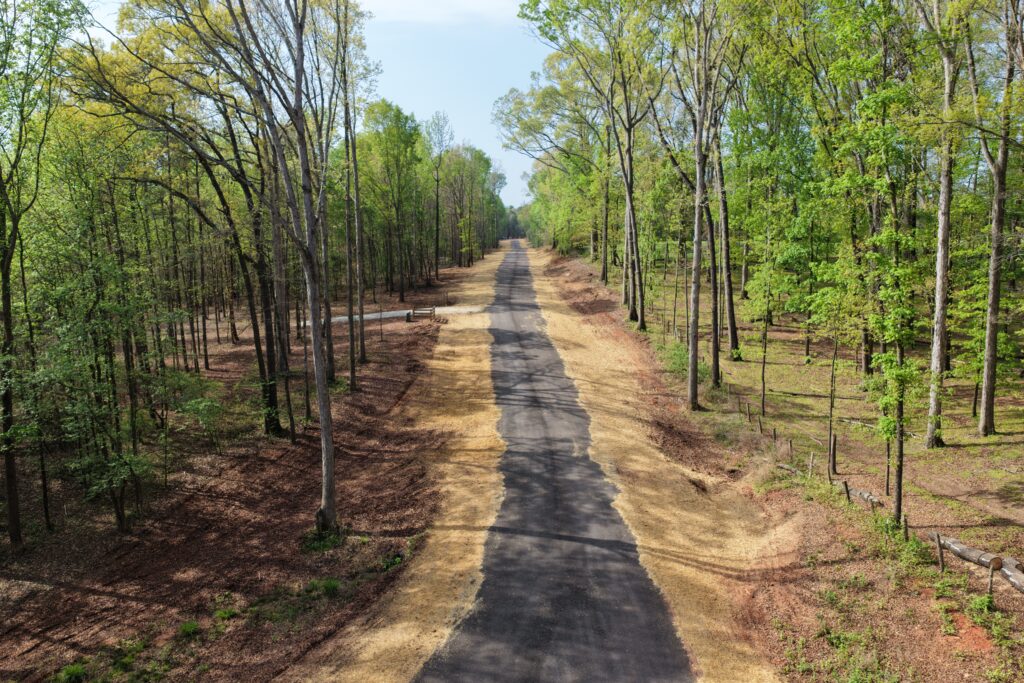
The road leading home shapes more than your route. It influences how easily you reach town, how much passing traffic you notice, how visitors find you, and how private your property feels at the end of the day.
For some buyers, public-road frontage offers the ideal balance of country living and everyday convenience. Others prefer a private road that creates distance between the homesite and the outside world. When comparing road frontage vs. private-road access, the right answer depends on the experience you want, not simply the label attached to the road.
Here is how the two settings compare in convenience, privacy, visibility, driveway placement, traffic, and daily life.
What makes the difference?
Public-road frontage generally provides direct access from a road maintained by a county, municipality, or state agency. It can make a property easier to reach, identify, and navigate.
A private-road setting often places the property beyond the public road, creating a more secluded approach. The road may serve one parcel or be shared by several property owners. Its use and maintenance are usually governed by ownership documents, easements, or road agreements.
These categories can overlap. A property can have frontage on a private road, for example. For this comparison, “road frontage” refers to direct frontage and driveway access along a public road, while “private road” refers to property reached by a privately owned or maintained road.
Neither setting is automatically better. The best choice is the one that supports how you expect to use and enjoy the property.
Public-road frontage and private-road living at a glance
|
Consideration |
Public-road frontage |
Private-road setting |
|
Convenience |
Often provides direct, straightforward access |
May involve a longer or shared approach |
|
Privacy |
Depends on setback, terrain, vegetation, and traffic |
Often creates more separation from public traffic |
|
Visibility |
Usually easier to see and locate |
Often less visible from the public road |
|
Driveway placement |
Must work with road conditions, sight distance, and terrain |
May offer a more secluded approach but can involve shared-road limitations |
|
Traffic |
Influenced by the type and volume of public-road traffic |
Usually has fewer casual passersby, although neighbors may share the road |
|
Maintenance |
The public road is generally maintained by a government authority; the owner maintains the driveway |
Owners may share responsibility under a private agreement |
|
Overall experience |
Accessible, connected, and easy to find |
Secluded, quiet, and retreat-like |
These are general tendencies. A quiet public road may feel more private than a shared private road serving several homes. The setting must be evaluated property by property.
Public-road frontage can simplify everyday travel
One of the strongest advantages of public-road frontage is convenience. You can often turn directly from the public road into your driveway without traveling through another privately maintained route.
That direct access can make daily routines feel easier. Guests can find the address without navigating a series of turns. Deliveries, contractors, and service providers may have a more straightforward route. If you expect to commute regularly, make frequent trips into town, or welcome visitors often, that simplicity can matter.
Road frontage does not always mean living close to traffic. A thoughtfully placed homesite may sit far back from the road, screened by trees or positioned beyond a rise in the land. A curved driveway can create a gradual approach while preserving direct public-road access.
The character of the road matters as much as its ownership. Frontage on a quiet county road creates a different experience from frontage on a busy route. Buyers should pay attention to traffic speed, road width, nearby intersections, and activity at different times of day.
A private road can make arriving home feel like a retreat
A private road can create a sense of transition. Instead of turning directly into a visible driveway, you may travel farther through trees, across open land, or around the natural contours of the property before reaching the homesite.
For buyers seeking seclusion, that approach may be part of the appeal. Distance from the public road can reduce exposure to passing vehicles, headlights, and casual observation. The home may feel tucked into the acreage rather than presented to the road.
Privacy, however, is not guaranteed by the word “private.” A private road may serve several neighboring properties, and residents, guests, service vehicles, or contractors may use it regularly. The number of users, proximity of neighboring homes, road alignment, and surrounding vegetation all shape the actual experience.
The right question is not simply, “Is it a private road?” It is, “Who uses this road, how often, and what will I see and hear from the homesite?”
Visibility can be an advantage or a tradeoff
Some buyers want an entrance that is easy to recognize. Greater visibility can help visitors, delivery drivers, emergency responders, and contractors locate the property. It can also make the arrival feel more open and connected.
Other buyers would rather have a property that is difficult to notice from the public road. A less visible entrance may reinforce the feeling of getting away, particularly when the road curves, the landscape provides natural screening, or the homesite sits well beyond the property entrance.
Consider how much separation you truly want. Complete seclusion can be peaceful, but it may also mean giving more detailed directions, maintaining a longer drive, or planning for gates and signage. Greater visibility offers convenience, but it may require additional landscaping or a deeper setback to create the desired privacy.
Neither preference is more correct. The choice depends on whether you want your property to feel outward-facing, discreet, or somewhere between the two.
Driveway placement may matter more than the road label
A road may look ideal from a map or listing, but the driveway determines how the property works in practice.
For public-road frontage, buyers should consider where a driveway can safely meet the road. Sight distance, traffic speed, drainage, slope, and county or state requirements may influence the entrance location. The most visually appealing spot is not always the most practical one.
On a private road, the approach may already be partially defined. An easement or existing entrance could determine where vehicles enter the parcel. Shared-road agreements may also affect gates, additional entrances, or changes to the road.
From there, the driveway must connect naturally with the preferred homesite. A steep or winding route may offer privacy and beautiful views, but it may require more planning for construction access, drainage, trailers, and everyday travel. Buyers should also consider room for parking, deliveries, and vehicle turnarounds.
Walk the entrance, potential driveway route, and homesite as one connected system. The experience between the road and the future front door can reveal more than the access description alone.
Evaluate traffic by type, timing, and proximity
“Is the road busy?” is a useful starting question, but it is not specific enough to guide a decision.
Notice how many vehicles pass, how fast they travel, and what kinds of vehicles use the road. A route may be quiet for most of the day but active during morning and evening commuting hours. Other roads may carry school traffic, farm equipment, trucks, or weekend visitors.
Listen from the likely homesite rather than judging traffic only from the property entrance. Elevation, trees, distance, and terrain can change how much road noise reaches the building area. On an unpaved road, dust may be another consideration. After dark, passing headlights may matter more than daytime visibility.
Private roads deserve the same evaluation. A road serving several year-round homes may have more regular activity than expected. A road serving only a few large tracts may remain quiet for long stretches.
When possible, visit a property at more than one time of day. A second visit can provide a more complete sense of its everyday rhythm.
Private-road access deserves a closer look at the documents
The character of a private road may be easy to experience during a property tour. The legal and maintenance arrangements require document review.
Buyers should confirm whether the property has recorded legal access, who is permitted to use the road, and who is responsible for maintenance. If several owners share the road, determine whether a written road-maintenance agreement explains how work is approved and expenses are divided.
The road itself should also be evaluated. Consider its width, surface, drainage, condition, gates, and turnaround areas. Ask whether builders, utility providers, delivery vehicles, and emergency services can reach the intended homesite. Lenders may also request documentation related to legal access or road maintenance.
A road’s appearance does not establish access rights. Review the survey, deed, recorded easements, road agreements, and applicable county records with the appropriate qualified professionals before purchasing.
Which setting fits the way you want to live?
Public-road frontage may suit you if you value direct access, expect frequent visitors or deliveries, and prefer a property that is easy to locate. It can also work well for privacy-minded buyers when the acreage provides enough room to place the home away from the road.
A private-road setting may suit you if seclusion is central to your vision. You may enjoy a longer approach, fewer casual passersby, and a stronger feeling of leaving public activity behind. You should also be comfortable reviewing access rights and understanding how road maintenance is handled.
As you compare properties, ask:
- How often will I travel this road during a normal week?
- How much separation do I want from passing traffic?
- Where can the driveway safely and practically enter?
- How easy will access be for guests, deliveries, and builders?
- What traffic or road noise reaches the likely homesite?
- Who owns, uses, and maintains the road?
- How does the full arrival experience make me feel?
Experience the road before choosing the homesite
The road is not merely a way into the property. It shapes daily errands, the welcome visitors receive, the privacy surrounding the homesite, and the feeling of returning home.
That is why buyers should look beyond “public” and “private.” Consider the entire journey, from the first turn off the main route to the future front door.
If you are ready to see how this plays out on real North Georgia land, view our available lots to compare access types across current properties, or schedule a land tour to walk a homesite and experience the setting for yourself.