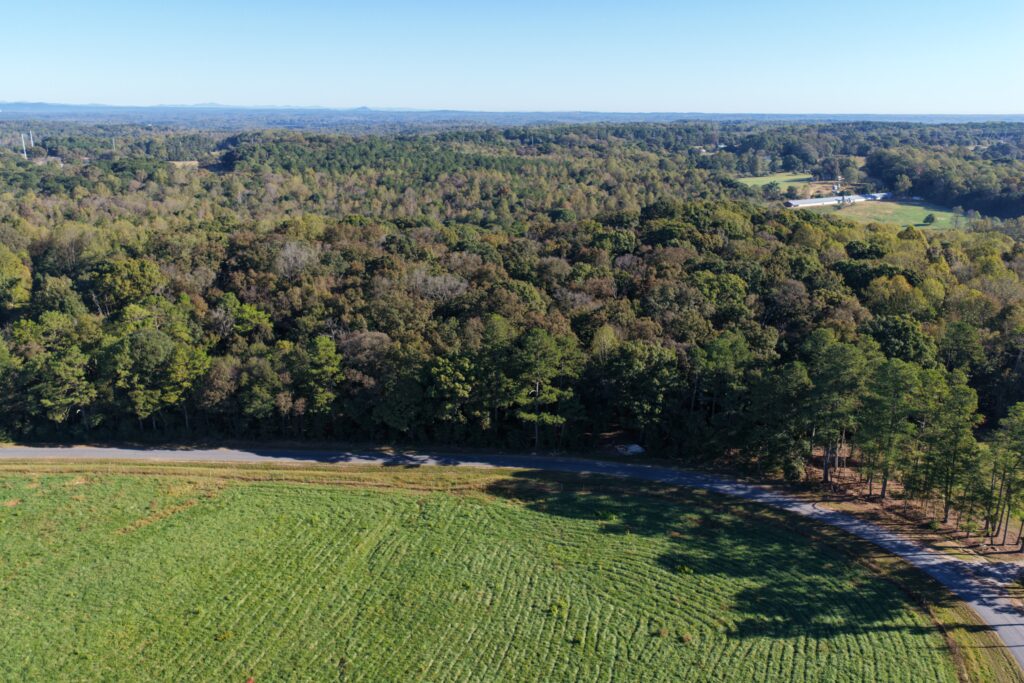
You already know which trees you want to keep. The oak that will shade the back porch. The line of hardwoods that hides the road. The one the kids will end up climbing.
Most people protect those trees by telling the builder not to cut them down. That is not enough. The trees people lose after building are rarely cut. They are driven over, trenched past, and buried a few inches too deep, and they die slowly, years after the crew has gone.
A mature hardwood takes decades to grow and cannot be replaced in time for you to enjoy it. Protecting one takes a fence, a conversation, and about an hour of planning before the first truck arrives. Here is how to do it.
Three things about roots that change the plan
Roots are wide and shallow, not deep. Most people picture a tree’s roots as a mirror image of its branches, reaching straight down. In fact, UGA Extension reports that most active roots sit in the top 12 inches of soil, and most extend two to five canopy diameters out from the trunk. A tree with a 30-foot canopy can have roots 60 feet away or more. In heavy soil like Georgia clay, roots stay even closer to the surface because that is where the oxygen is.
A few inches of soil can be fatal. Spreading leftover dirt around a tree looks harmless. It is not. Fill blocks the air and water roots depend on. According to UGA Extension, a tolerant tree may survive 6 inches of well-drained fill, while a sensitive one may not survive 2.
The damage shows up years later, and it cannot be undone. Heavy equipment presses the air pockets out of soil, and those pockets do not come back. UGA Extension notes it may take several years for the effects of compaction to become obvious. Wet soil compacts worst of all. By the time the canopy thins, the cause is long gone and so is the chance to fix it.
Put those three together and the job becomes clear. You are not protecting a trunk. You are protecting a wide, shallow circle of ground.
Step 1: Pick your trees before anyone else does
Walk the land with a roll of flagging tape and mark the trees you would be sorry to lose. Five or six is plenty. Trying to save everything usually means nothing gets real protection.
Be honest about location. A tree standing a few feet from the future foundation, driveway, or septic field will lose a large share of its roots no matter how careful the crew is. It is better to decide that now than to watch it decline beside a finished house.
If a tree matters a great deal to you, have an ISA Certified Arborist look at it before the house plan is final. Species, age, and condition all affect how much disturbance a tree can take, and the International Society of Arboriculture points out that small design changes made early can greatly reduce the damage. Moving a driveway six feet on paper is free. Moving it after it is graded is not.
Step 2: Fence the ground, not the tree
The edge of the branches, called the dripline, is the smallest area worth fencing, not the goal. Since roots run well past it, give each tree as much room beyond the dripline as the site allows. An arborist can mark the exact line for trees close to the work.
Then make the boundary impossible to miss:
- Use real fencing, not a strip of tape. Tape gets driven over.
- Put it up before clearing or deliveries begin, not after.
- Hang a sign on it saying why the area is closed and who to call before entering. The ISA recommends this, and it works on subcontractors who were never at your planning meeting.
Inside the fence, nothing happens. No vehicles, no parked equipment, no stacked lumber, no soil piles, no concrete washout, no burn pile.
Step 3: Have the conversation, and put it in writing
Builders are not careless about trees. They are busy, and nobody told them which ones matter. Tell them, early, in plain words:
“These flagged trees are staying. I’d like them fenced before any equipment comes in, and I’d like the fences to stay put until the job is done. Can you show me where trucks will enter, where materials will be stacked, and where every trench will run?”
Then ask four questions:
- Where does the digging go? Trenching cuts every root in its path. Ask whether a line can be rerouted or, near a tree you care about, tunneled under the roots instead.
- Where does the extra dirt go? Agree on a spoil pile location well away from your trees, and agree that leftover soil will not be spread under them at the end.
- What is the one route in and out? A single path for trucks compacts one strip of ground. No set route compacts all of it.
- Who do subcontractors call before moving a fence? A delivery driver looking for a place to turn around can undo your plan in ten minutes.
Ask for the tree protection plan to be written into your build agreement or site plan. A verbal promise does not reach the concrete crew.
What is already handled on a Build Ready lot
Two of the hardest jobs on tree roots are the driveway and the power trench. On a Millwood Build Ready property, those are done before you ever own the land: the driveway is installed, the homesite is partially cleared, and underground power is installed.
That leaves a shorter list to plan around. The digging still ahead is the work for your home itself: the foundation, your private well, and your septic system. And because the homesite is only partially cleared, the trees around it are yours to choose. Walk them with your builder before the house is staked, and you decide which ones frame the view.
Step 4: Check the fences every visit
Each time you visit the site, walk the fence lines. It takes five minutes. Look for three things: a fence that has moved, tire tracks inside it, and anything stacked or dumped under a tree.
If something has gone wrong, say so that day. If roots have been cut or exposed, a trunk has been hit, or soil has been piled against a tree, call an arborist. Roots can sometimes be cut cleanly and the tree watered through the stress, but only if someone acts quickly. Green leaves this summer do not mean the tree is fine.
It is also worth a little care after move-in. Keep vehicles off the root zone, water during dry spells for the first couple of years, and watch the top of the canopy. Thinning there is the early sign.
The one-page version
Before construction:
- Flag the five or six trees you most want to keep.
- Have an arborist look at any that sit close to the planned work.
- Fence past the dripline, with signs, before equipment arrives.
- Agree on one truck route, one storage area, and one spoil pile.
- Review every trench: well line, septic, and anything else underground.
- Get the plan in writing.
During construction:
- Walk the fences on every site visit.
- Keep all traffic off wet ground near your trees.
- Make sure no soil is spread under the trees at final grading.
- Call an arborist the same week if a tree is hit or roots are cut.
The trees are part of what you are buying
The house can be built in a season. The oak beside it took most of a century. An hour of planning before the first truck arrives is what keeps it standing over your porch long after the build is done.
Looking for acreage with trees worth keeping? Millwood’s Build Ready properties in Jackson County have no HOA and no deed restrictions, so what stays and what goes is your call. [Schedule a land tour] and walk the trees yourself.